
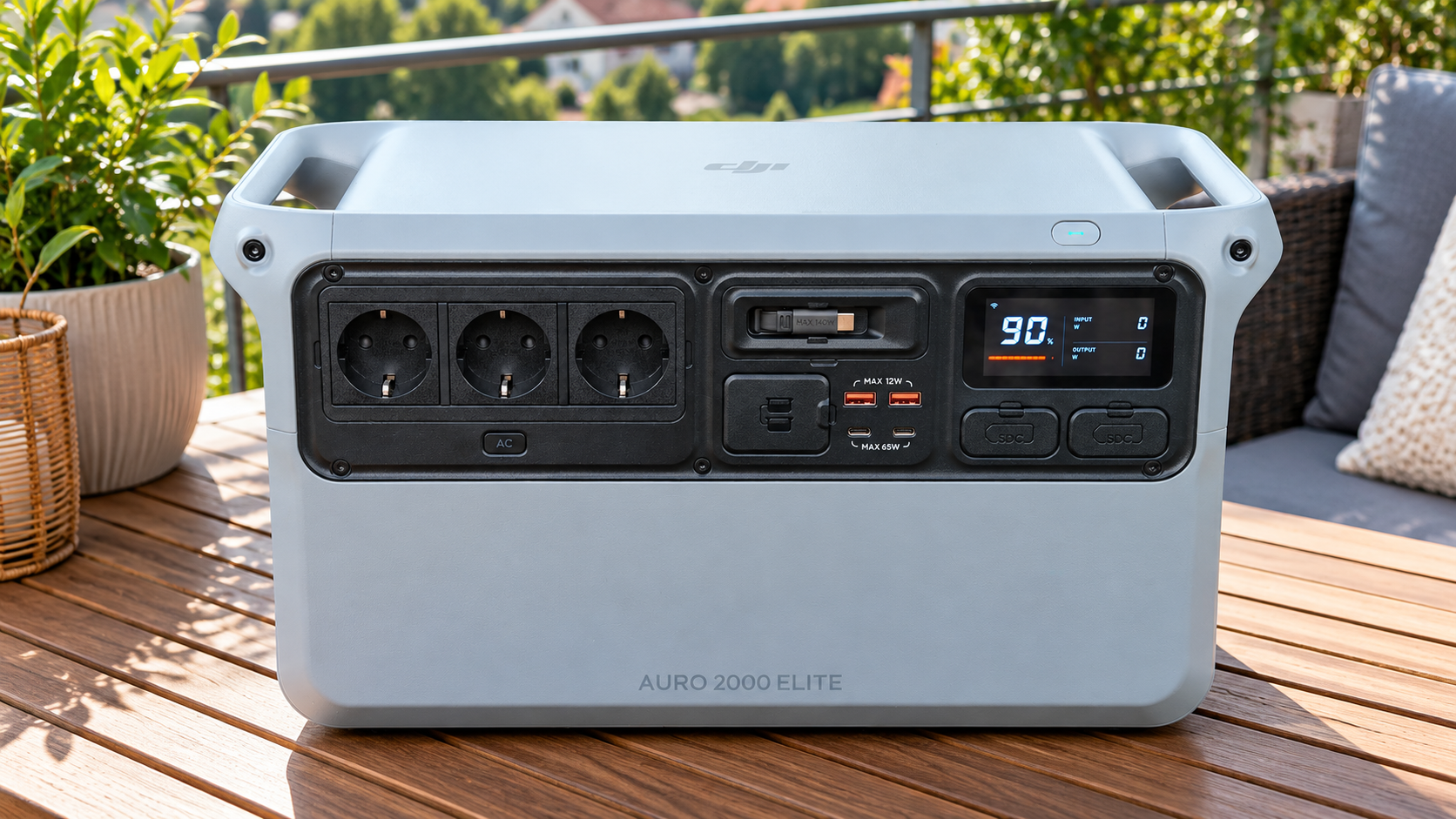
Design and workmanship
With a battery capacity of 2.016 Wh, the DJI Power Auro 2000 Elite is among the more powerful portable power stations. Despite this, the housing, measuring approximately 45,6 × 22,5 × 24,5 centimeters, is relatively compact, but it weighs 19 kilograms. While this makes it still portable, it is better suited for stationary use while camping, in a camper van, or as a mobile power reserve at home.
Visually, DJI has opted for the typical gray color scheme already familiar from its drones and other products. The overall build quality makes a solid impression, the ports are clearly arranged, and the display is easily readable even from a distance. Only the plastic covers of some ports stand out upon closer inspection, as they are, in my opinion, a bit too thin and appear less premium than the rest of the casing.
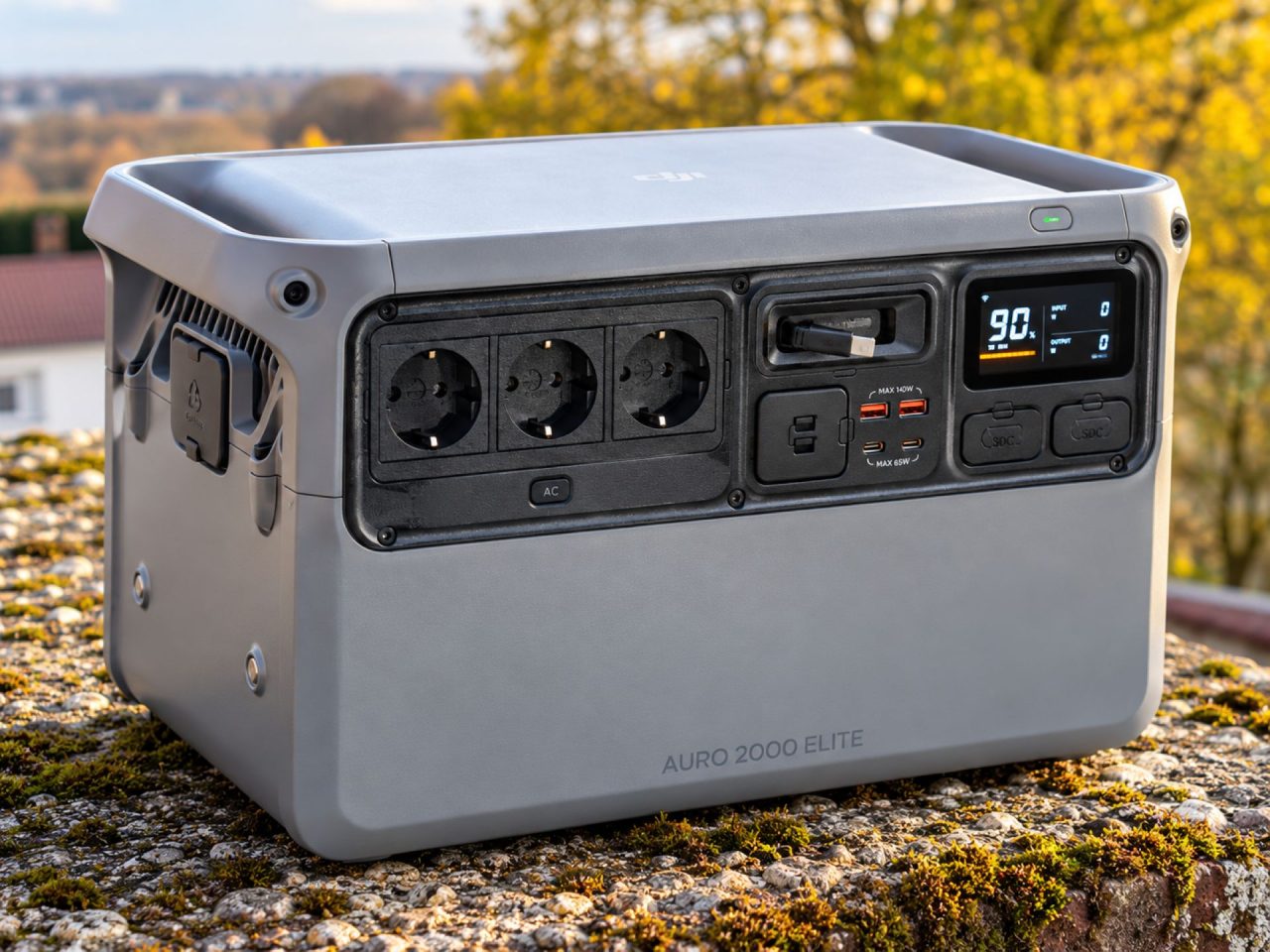
I would have liked protective covers for the three 230V sockets to shield the connections from dirt and dust. Furthermore, the IP30 rating offers no protection against water ingress, making the Auro 2000 Elite only conditionally suitable for unprotected outdoor use.
Connections and features
DJI equips the Power Auro 2000 Elite with three 230V power outlets, two USB-C ports (each capable of up to 65W), and two USB-A ports (each capable of up to 12W). The package is further enhanced by two SDC ports for compatible DJI accessories and an integrated USB-C cable that delivers significantly more power (up to 140W) than the other USB ports.
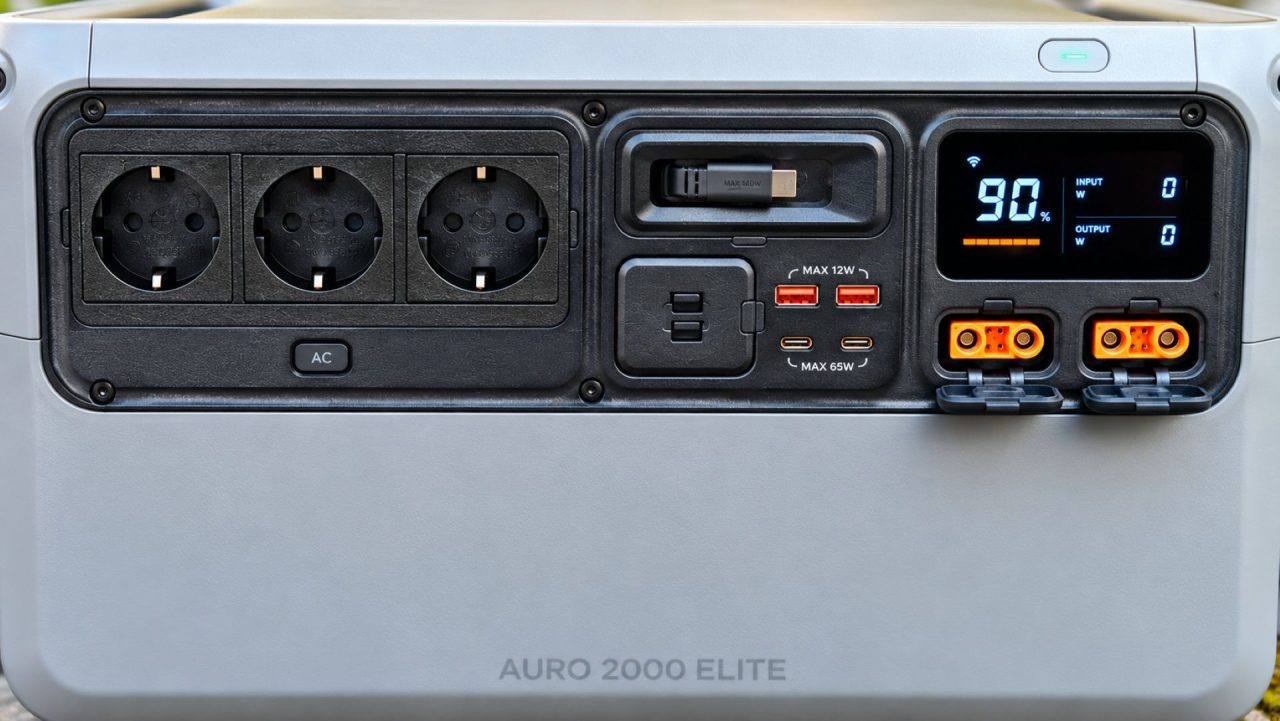
The three power outlets share a total output power of 2.000 W. Compatible DJI drone batteries and accessories can be charged via the two SDC ports. The included adapter for a 12V car socket is also powered via one of these ports. This allows, for example, the connection of suitable coolers or other 12V devices.
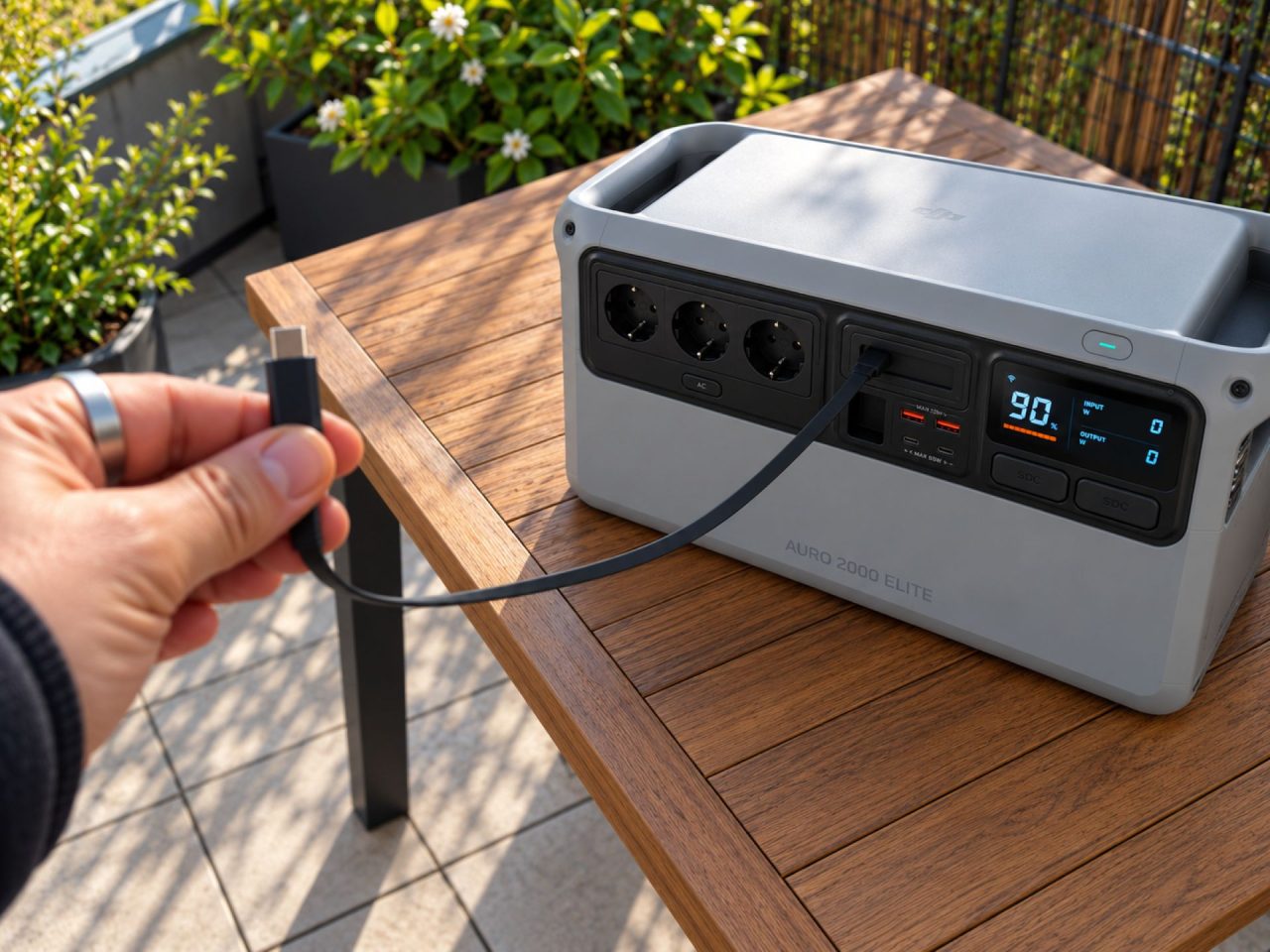
Integrated USB-C cable
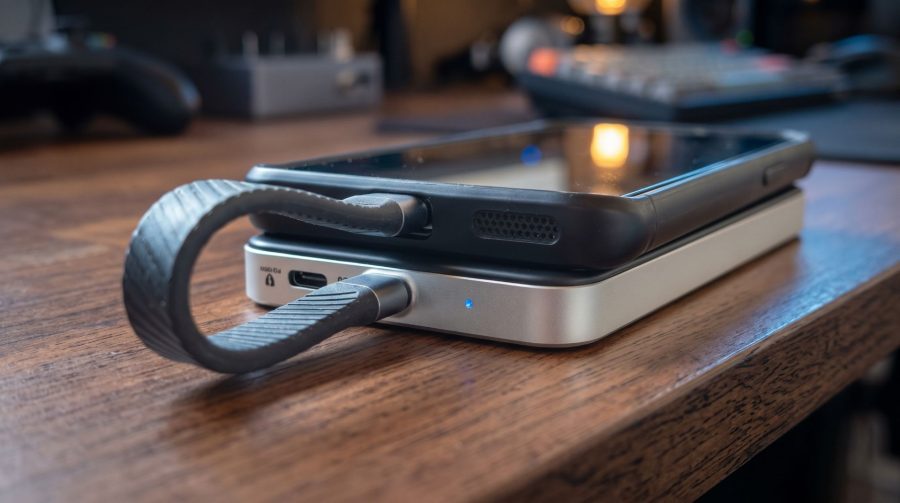
The permanently integrated USB-C cable can be pulled directly out of the housing and, at approximately 80 centimeters long, offers ample slack to place a smartphone or laptop next to the power station. After use, it retracts back into its designated slot via the retraction mechanism. I recommend guiding the connector by hand while retracting it to prevent it from hitting the housing uncontrollably. Should the cable become damaged, DJI offers a replacement cable module without requiring a complete power station replacement.
For me, the cable is one of the most practical features of the power station, as it's always readily available and I don't need a separate cable to charge my smartphone or laptop. With up to 140W via USB Power Delivery 3.1, even more powerful laptops can be easily powered.
Notebook, smartphone and speakers put to the test
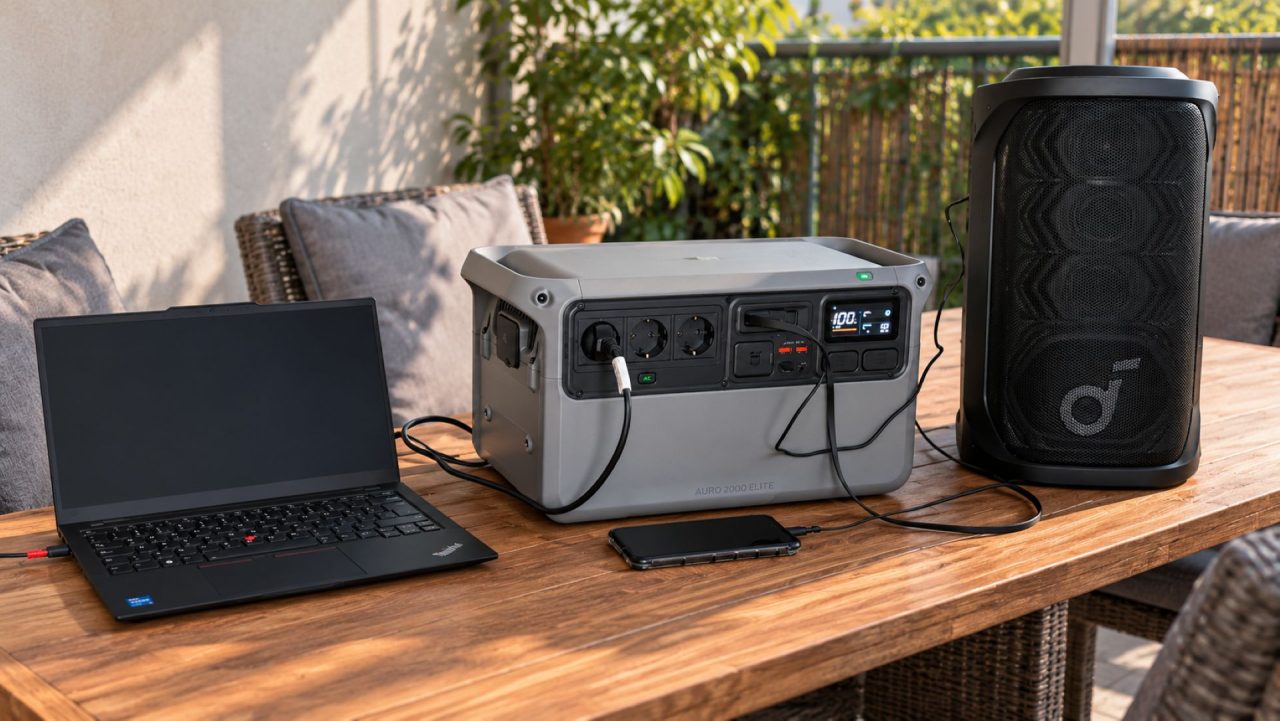
For my first everyday test, I connected a Lenovo notebook, a Huawei P60 Pro, and a Soundcore Bluetooth speaker to the power station simultaneously. While the notebook was powered via one of the 230V sockets, I charged the smartphone and speaker via USB-C, also using the integrated charging cable.
All three devices operated simultaneously without any issues, with the DJI Home app displaying a total output power of 91 W during a measurement. Of this, 63 W was attributable to the notebook, and a further 17 W and 11 W to the two USB-C connections. The values are displayed separately in the app, making it easy to track the power consumption of each connection.
Theoretically, the battery would last approximately 22 hours under this load if all the stored energy could be used without loss. However, since losses occur during the conversion to alternating current, and the power station itself also consumes energy, the actual runtime is shorter. Assuming, for example, that 80 to 90 percent of the energy is usable, roughly 18 to 20 hours would be realistic under these conditions. During my test, the DJI Home app displayed a remaining runtime of 15 hours and 29 minutes.
I was also impressed by the low operating noise. At this low load, the power station was barely audible, so it didn't disturb anyone even in a quiet environment.
Household appliances push the power station to its performance limit
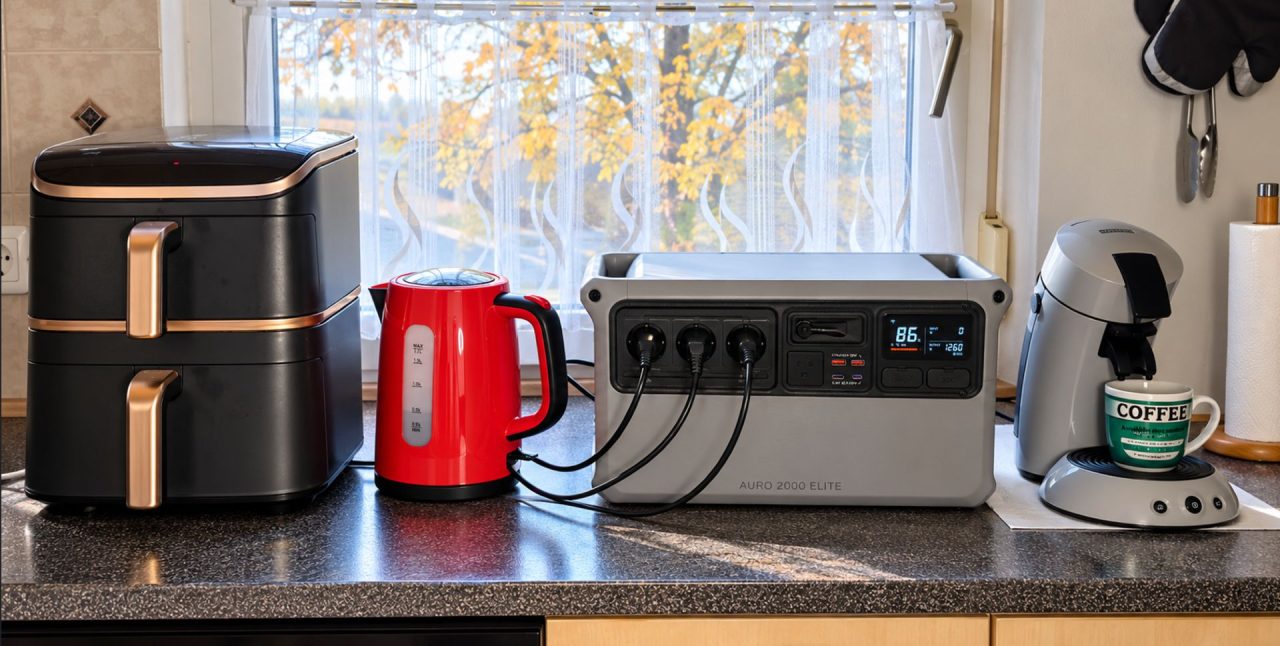
I then tested how the 2.000 W output power performed with high-performance household appliances using a kettle, a COSORI hot air fryer and a Senseo coffee machine.
The kettle alone, at 1.992 W, drew almost the entire available output power, but it worked flawlessly and brought the water to a boil quickly. It was to be expected that there would be no reserve power for other appliances under this load. When I also switched on the air fryer, a distinct click was heard, and the power station, as expected, cut off the power supply. The overload protection reacted exactly as it should, preventing further overloading of the outputs. After a restart, I was able to use the connected devices again.
In subsequent standalone operation, the COSORI air fryer, set to a temperature of 230 °C, showed a power consumption of approximately 1.260 W, leaving some headroom for smaller appliances. After 30 minutes of operation, the power station still showed 68 percent battery capacity, based on a fully charged battery. Given the previous overload, I refrained from also operating the coffee machine.
In addition to the overload protection, which was successfully triggered in the test, the Auro 2000 Elite features further safety mechanisms. Thirteen temperature sensors monitor heat development, while 40 fuses and protective components, along with the integrated battery management system, protect against overheating, overvoltage, and short circuits, among other things.
Mains charging and battery management
When charging via a standard wall outlet, the Auro 2000 Elite supports a maximum input power of 2.000 W. Under optimal conditions, the battery can be charged to 80 percent in approximately 60 minutes and fully charged within 75 minutes. The charging speed can also be adjusted via the app between 200 and 2.000 W, which is particularly useful when using the power station with a lower amperage outlet or when you want to deliberately slow down the charging process.
Inside, DJI uses lithium iron phosphate cells, or LiFePO4 for short, which the manufacturer states retain more than 80 percent of their original capacity after 4.000 charge cycles. With a full charge and discharge every day, this would theoretically correspond to almost eleven years of use, although the actual aging is naturally also influenced by temperature, storage, and charging habits.
Those needing more than the integrated 2.016 Wh can expand the Auro 2000 Elite with up to five compatible expansion batteries, reaching a total capacity of approximately 12 kWh. However, the Auro series uses its own proprietary expansion system and is not compatible with the DJI Power Expansion Battery 2000. Therefore, users who already own expansion batteries for an older DJI power station cannot simply reuse them.
The DJI Home App in practical use
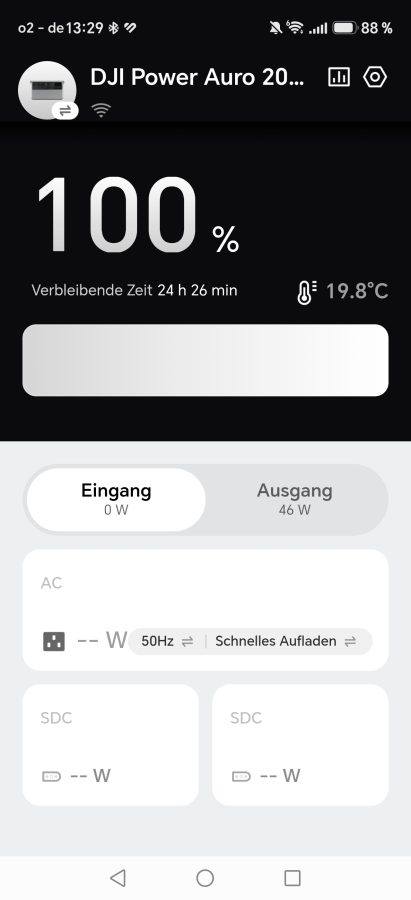
The DJI Home app allows for extensive configuration of the Power Auro 2000 Elite, and I was particularly impressed by the comprehensive energy management options. In addition to AC charging power, you can set individual charging and discharging limits, configure automatic shutdown times, and create charging and discharging schedules. The latter can be especially useful with dynamic electricity tariffs, allowing you to prioritize charging the power station during off-peak hours.
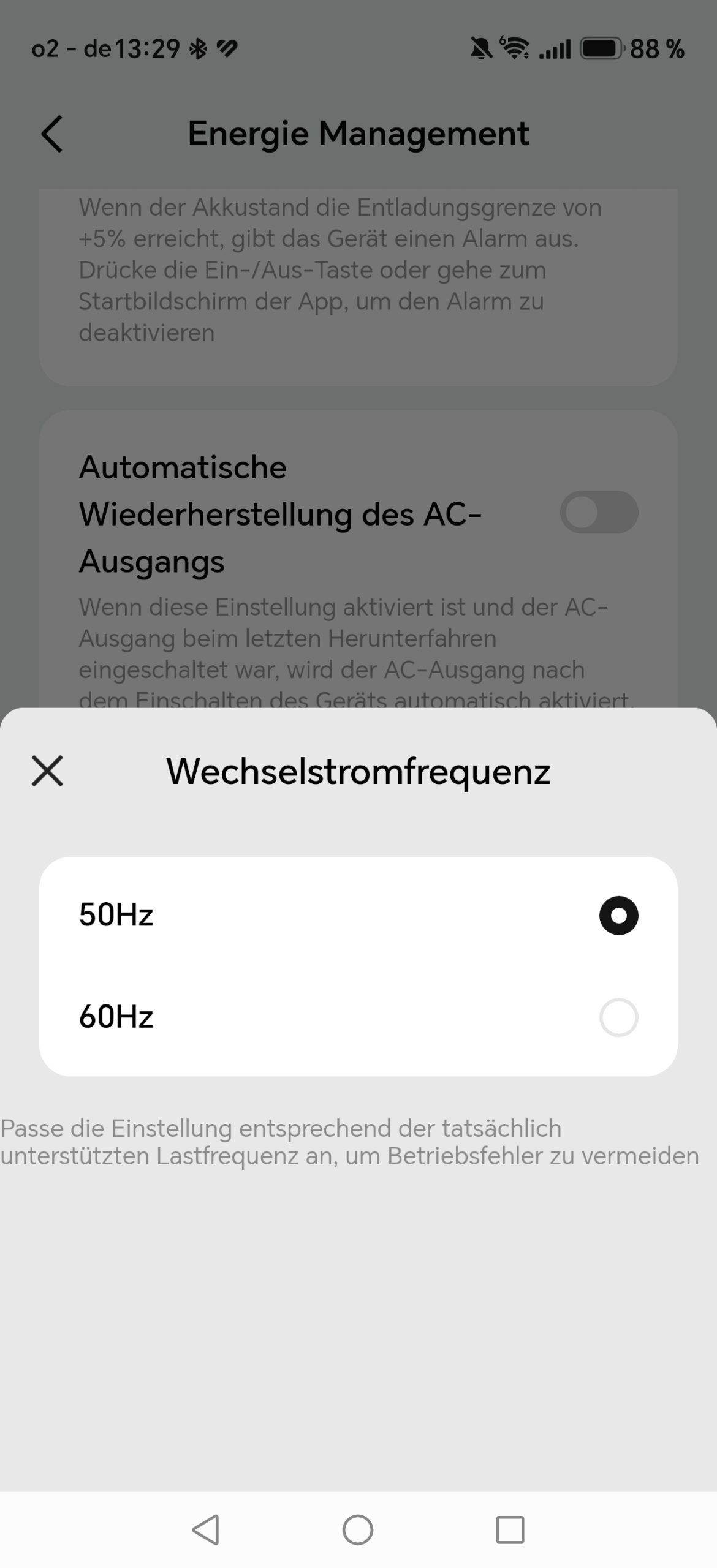
In addition, the app offers a cable resistance test, automatic restoration of previously switched-on AC outputs after a restart, and the ability to switch the output frequency between 50 and 60 Hz.
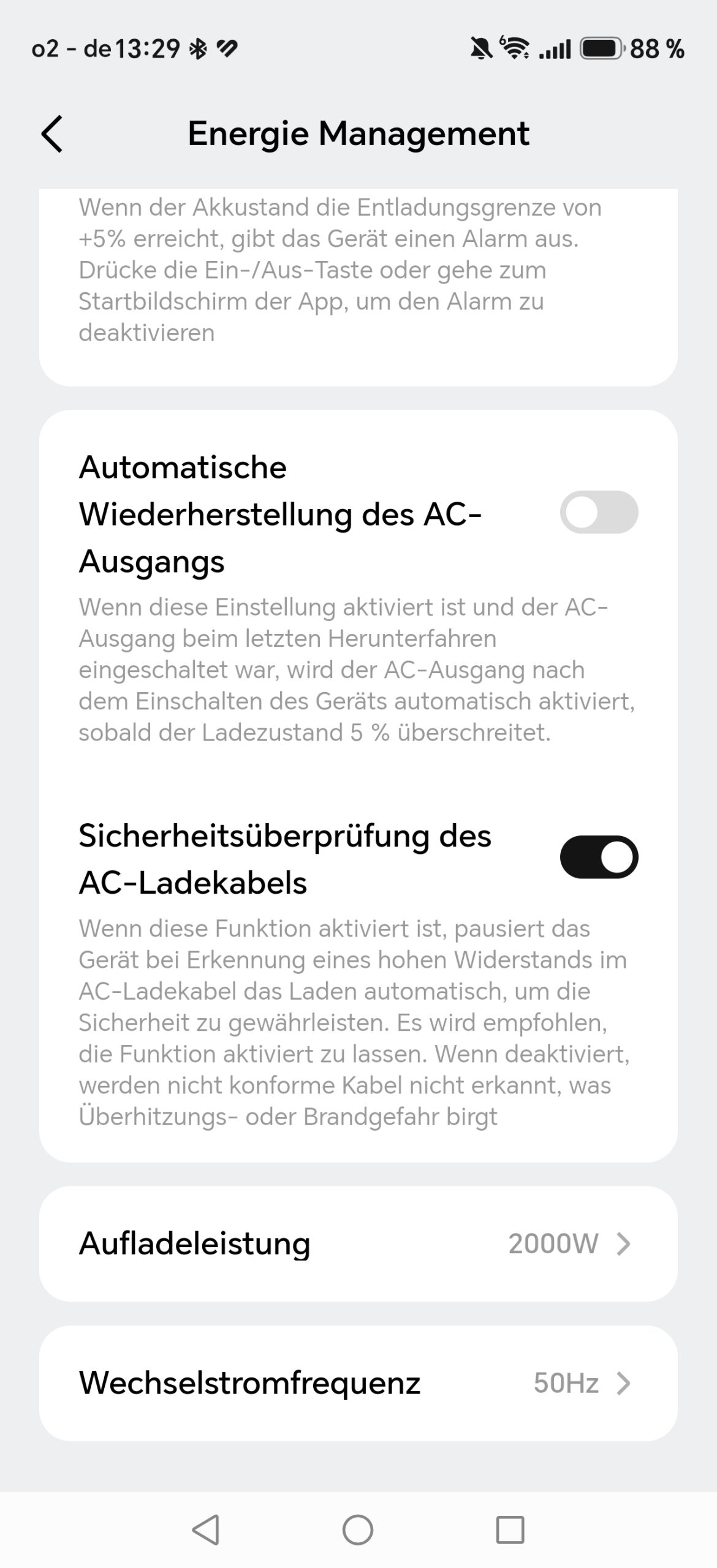
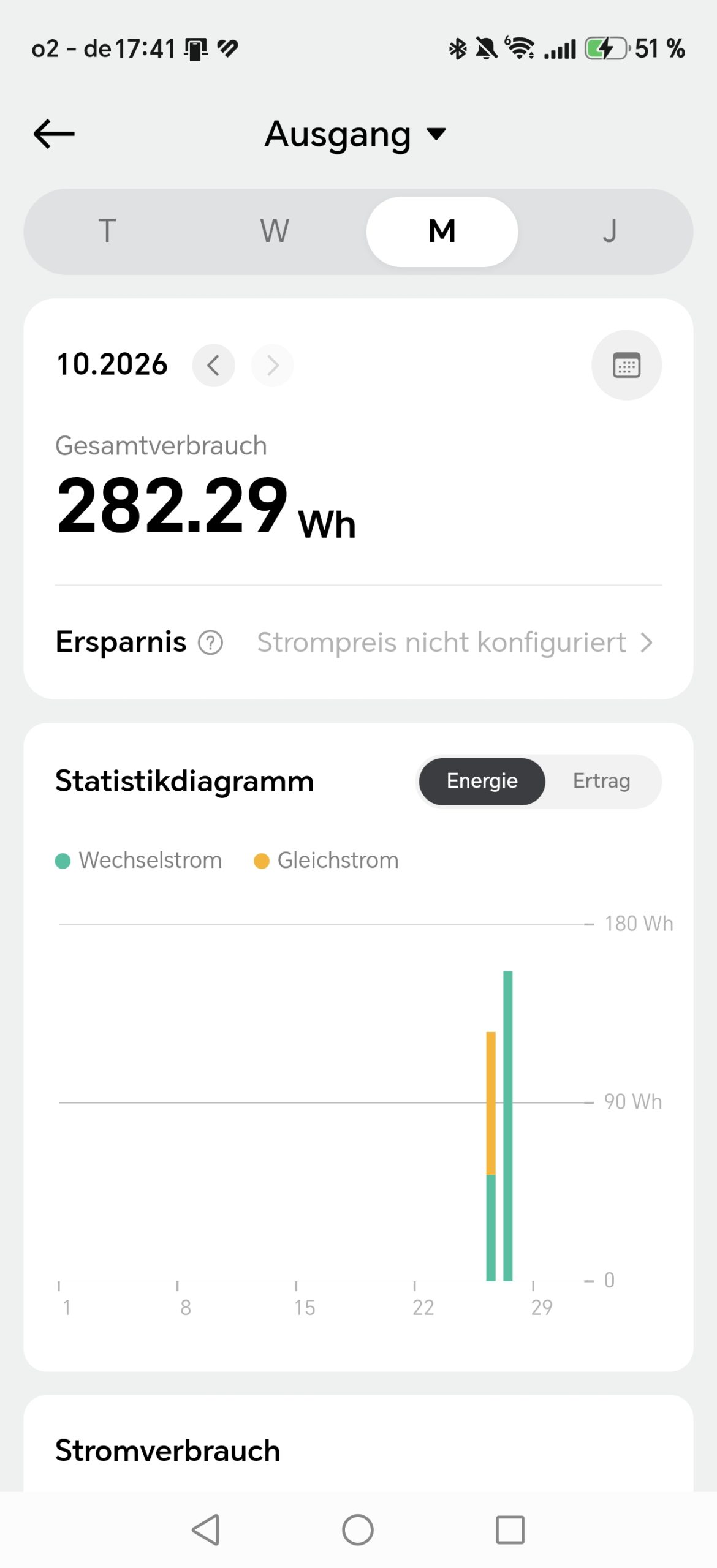
The app also provides statistics on energy consumption. In addition to daily and weekly values, monthly overviews are also available, allowing users to track energy consumption retrospectively. The interface is generally clear and easy to use, although the German version isn't entirely error-free. On our smartphone, several longer menu items were truncated, including those in the energy optimization settings.
Solar charging and power supply in the vehicle
Compatible solar panels with a total output of up to 1.200 W can be connected via the two SDC ports, with each input supporting a maximum of 600 W. Under optimal conditions, the battery can be fully charged in approximately 2,7 hours.
More interesting is the vehicle charging option, for which DJI has already integrated a corresponding charging module. Using the separately available connection cable, the power station can be charged directly via the vehicle battery, with up to 400 W possible on 12V systems and up to 600 W on suitable 24V or 48V systems. Compared to charging via a standard 12V vehicle socket, this significantly reduces the charging time.
Compared to the older DJI Power 2000, both charging methods eliminate the need for additional external charging modules, as the MPPT solar charge controller and the vehicle charging technology are already integrated into the housing. However, suitable connection cables are still required and must be purchased separately.
Price and availability
The DJI Power Auro 2000 Elite is now available for €1.099 from the official DJI online store and authorized retailers. Accessories such as solar panels and compatible cables are sold separately.
Those who need less battery capacity will find a suitable option with the DJI Power 1000 Mini a more compact alternative, which I have also already tested.



Bernd
Hi
Thanks for this valuable information. I want to use this power bank in my camper, but also as a home battery in winter. If I understand correctly, the power bank can be connected to a Shelly 3em pro, and when drawing power from the grid, the battery feeds into the house's electrical system, and when there's excess solar power, the power bank is recharged, either with excess solar power from the solar panels on the roof, or from two solar panels directly connected to the power bank.
Is that correct, and can it do that without any additional accessories?
Thanks in advance for your assessment.
Christian Matenar
Hi Bernd!
Yes, your idea works very well in principle, however there are two important details to consider regarding accessories and charging control:
Feed-in to the house network (Shelly):
This works directly via the DJI Home app. If a Shelly Pro 3EM is installed in the meter box, the Auro 2000 Elite can act as a storage device and dynamically charge up to [amount missing] when drawing power from the grid.
Feed 800 W into the house network.
Charging via solar panels:
Modules connected directly to the power station: Works perfectly via the SDC inputs.
Important regarding accessories:
The appropriate DJI SDC-to-MC4 solar charging cables are not included and must be purchased separately.
Excess power from the rooftop system (via AC):
Charging via the wall socket can be controlled via charging schedules in the app. However, continuously dynamic AC surplus charging solely via the Shelly currently requires a separate smart home automation system (such as Home Assistant).
The Auro 2000 Elite is therefore very well suited for your combination of camper in the summer and home storage in the winter – you basically only need to plan for the SDC solar adapters for your own modules!
Greetings Christian